
Executive Summary
India has demonstrated remarkable success in building national digital infrastructure across sectors such as digital identity, banking, digital payments, telecommunications, and public services.
Healthcare now stands at a similar point of digital transformation.
Unlike most digital infrastructures, healthcare information accompanies every individual throughout life. Each stage of care contributes to a lifelong health journey, creating information that should remain connected and accessible when needed. This continuity of information is essential to support informed care, patient safety, and better healthcare outcomes.
Despite advances in medical science and digital technology, healthcare information remains fragmented across hospitals, clinics, diagnostic laboratories, pharmacies, and other healthcare providers. Different systems and formats make information difficult to connect, access, and use across the healthcare ecosystem, limiting continuity of care and a complete view of the patient’s health history.
Recognizing these challenges, the Government of India has established important digital health foundations through initiatives including EHR Standards, Ayushman Bharat, ABHA, and the Ayushman Bharat Digital Mission (ABDM), with standards, digital identities, registries, personal health records, and interoperable data exchange forming important building blocks of the emerging digital health ecosystem.
However, digital transformation requires more than converting paper records into electronic form. It requires healthcare information that is standardized, patient-centric, and consistently created, interpreted, exchanged, and reused across the healthcare ecosystem.
AMDEES presents a patient-centric framework for organizing healthcare information through standardized Healthcare Data Elements and common reporting structures. Rather than focusing on software, AMDEES focuses on the information that supports an individual’s lifelong health journey, creating a consistent foundation for continuity of care, interoperability, and future Electronic Health Records.
The framework supports the creation and organization of healthcare information across different stages of care and multiple healthcare providers, establishing a consistent foundation for connected healthcare information.
Developed through years of study, practical implementation, and experience with healthcare information systems, AMDEES demonstrates how standardized healthcare information can support patient registration, clinical documentation, investigations, reporting, and information exchange across multiple healthcare providers.
This document is neither a commercial proposal nor a software specification. AMDEES presents an approach to organizing healthcare information around the patient and the lifelong healthcare journey.
We invite organizations involved in developing and implementing healthcare information infrastructure to examine the framework and consider how its standardized, patient-centric information foundation could support and complement existing and planned healthcare initiatives, strengthening healthcare information for the nation and for generations to come.
AMDEES
Origin
The journey of AMDEES began in 2008 with a simple observation: while many forms of information had already moved into the digital world, healthcare information was still largely confined to paper records. While preparing to return to India, the need to obtain copies of family medical records raised a fundamental question: if information can move securely between institutions, why should an individual’s healthcare information remain confined to paper?
A second question emerged from the experience of comparing medical reports over time. Why should patients or healthcare professionals manually compare reports when healthcare information could be organized to reveal meaningful changes and trends? These questions became the foundation of AMDEES.
Purpose
The initial objective was to understand how healthcare information could be organized more effectively—not simply digitized, but structured so that information could remain useful, consistent, and accessible throughout a patient's healthcare journey.
This led to a broader examination of how healthcare information is created, recorded, reported, and used across different parts of the healthcare ecosystem.
Evolution
The search for answers first led to Electronic Medical Records (EMR), which initially appeared to be primarily a software solution. As the study expanded to the broader concept of Electronic Health Records (EHR), it became clear that the challenge extended beyond software to the way healthcare information is created, organized, shared, and used.
The broader examination introduced the importance of healthcare information, standards, interoperability, governance, privacy, education, and public policy. This led to a fundamental realization: technology cannot organize what healthcare has not first standardized.
The perspective gradually shifted from viewing healthcare as a collection of independent services to understanding it as an interconnected ecosystem. Diagnostics, care, and pharmacies became part of a continuous patient narrative, shifting the focus from individual providers to the patient and the lifelong flow of healthcare information.
This evolution in thinking provided the foundation for the practical work that followed—moving from understanding healthcare information to exploring how it could be structured, standardized, and applied in real healthcare environments.
Experience
The work developed through clinical research, study of pathology workflows, standardized reporting concepts, patient information management systems, pilot implementations, and collaboration with healthcare professionals and software developers.
Diagnostic services became an important area of practical development because laboratory information is structured and generated repeatedly throughout life. One practical outcome was a centralized online pathology reporting platform introduced in 2016, connecting 68 diagnostic laboratories across multiple regions of India, supporting more than two million patients and generating over six million diagnostic reports. These experiences provided practical insight into healthcare operations, information management, and technology implementation.
AMDEES Today
AMDEES is now centered on a simple principle: healthcare information should be organized around the patient and the patient's lifelong health journey. It is not designed around software or any single healthcare profession. It presents a structured approach to standardized healthcare information, intended to support consistent information creation, organization, reporting, and exchange across the healthcare ecosystem.
Principles
- Healthcare technology will continue to evolve.
- Software platforms will change.
- Standards will continue to evolve.
- Artificial intelligence will reshape healthcare.
The methods for creating, managing, exchanging, and using healthcare information will continue to evolve.
The guiding principles, however, should remain constant:
- Healthcare information exists to serve the patient.
- Healthcare information should follow the patient.
- Standardization precedes interoperability.
- Healthcare information should reveal insight, not merely accumulate data.
- Technology enables healthcare—it is not healthcare.
These principles place the patient at the center of healthcare information and provide a consistent foundation for its organization, exchange, and long-term use, regardless of changes in technology or healthcare delivery.
The challenge is not to predict how healthcare technology will evolve, but to ensure that the principles guiding healthcare information remain relevant as it does.
These principles provide the foundation for the practical framework presented in the following section. The concepts that follow demonstrate how standardized Healthcare Data Elements can be organized into patient registration, clinical reporting, and other healthcare documentation to create a connected and interoperable healthcare ecosystem.
Patient-Centric Architecture
Building a Standardized Platform
Introduction
Healthcare is fundamentally driven by precise patient health information, enabling healthcare professionals to make better clinical decisions and deliver quality care.
Individual healthcare organizations may provide excellent care within their own environments. The challenge begins when a patient’s healthcare journey extends beyond a single organization. Differences in patient registration, clinical reporting, terminology, and operational workflows can make healthcare information difficult to exchange, resulting in communication gaps, disrupted continuity of care, and reduced efficiency.
This architecture approaches healthcare information from the patient’s journey rather than individual provider workflows. It demonstrates how standardized healthcare information can support patient registration, historical healthcare information, clinical documentation, investigations, reporting, and other healthcare services throughout the patient’s healthcare journey.
Data Elements — The Common Information Foundation
Data Elements is the proposed National Standard Healthcare Data Element document that establishes a common information foundation for the healthcare ecosystem. It defines standardized healthcare information that can be assembled and reused to create the forms, clinical records, diagnostic reports, billing and administrative formats, prescriptions, discharge documents, and other healthcare documentation required across the system. Helping unify healthcare across organizations, services, and technologies.
For the structure, organization, and illustrative Healthcare Data Elements, see Supplement – Data Elements Framework
This pilot project demonstrates how standardized healthcare information can support a multi-facility healthcare environment and provide a foundation for a nationally interoperable Electronic Health Record (EHR) system.
Technology should implement standardized healthcare information; it should not define it.
Journey of Patient
Registration
The patient's healthcare journey begins with registration or admission, where the patient or an accompanying individual completes the required registration process and, where applicable, makes the necessary payment or deposit.
Healthcare organizations use different registration forms and terminology based on their individual operational requirements. In the absence of standardized guidelines, each organization develops its own registration process and documentation.
Forms
- Patient Registration Form
- Patient Registration & Admission Form
- OPD Patient Registration Form
- IPD Patient Registration Form
- Emergency Patient Registration Form
Challenges
These forms are designed primarily to meet the immediate operational requirements of individual healthcare providers. As a result, patients repeatedly provide the same information when visiting different healthcare facilities. This approach does not create a permanent patient healthcare identity, either personal or medical.
Universal Patient Registration
The proposed Universal Patient Registration Framework uses standardized Healthcare Data Elements to create a common registration structure for healthcare services. Instead of developing separate information standards for different registration forms, the same standardized Data Elements are used to establish a consistent patient registration structure and a permanent patient healthcare identity.
Registration Framework
The Universal Patient Registration Framework organizes the required patient information into a consistent structure while allowing the appropriate information to be captured for each healthcare service and encounter. This creates a common registration foundation that can be used across healthcare organizations while maintaining continuity of the patient's healthcare information.
Patient Registration Form
The figure presents an illustrative Patient Registration Form generated using standardized Healthcare Data Elements. The same information foundation can be used to create registration forms for different healthcare services while maintaining a consistent structure, permanent patient healthcare identity, and continuity of healthcare information throughout the patient's healthcare journey.
Patient Registration Form
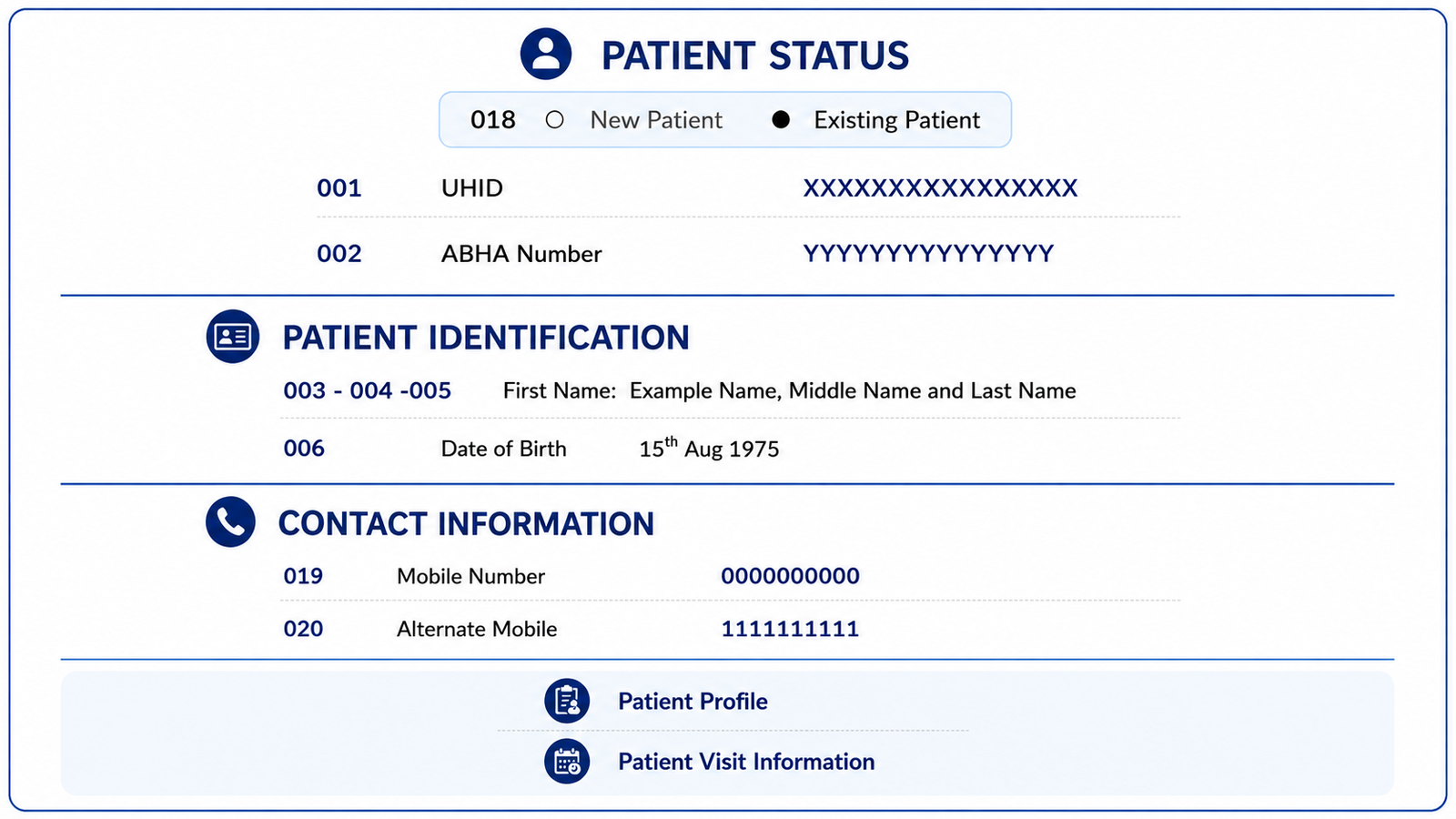
For a detailed explanation of the Universal Patient Registration Framework and its design principles, see Supplement – Registration Form. The Supplement – Data Elements Framework explains the standardized Healthcare Data Elements used to generate the Patient Registration Form.
Benefits:
- Creates a permanent patient healthcare identity.
- Collects patient information once whenever possible.
- Eliminates repetitive registration and duplicate data entry.
- Saves registration time and avoid hassle for All.
- A foundation for national interoperability.
Health History
In addition, the healthcare information system should provide a Historical Healthcare Information section that allows patients to upload their paper records, PDFs, CDs, old reports, and other historical healthcare documents, regardless of the number of records available. These records preserve essential healthcare information accumulated throughout the patient's lifetime. Illustrative examples of Historical Healthcare Information and its recommended categories are provided in Supplement – Health History
Availability
The Historical Healthcare Information section should be accessible through a secure patient portal as part of the healthcare information system. Registered patients, their authorized representatives, or approved agencies may upload historical healthcare records from paper or digital sources at their convenience. These records provide healthcare professionals with valuable clinical context, supporting better clinical decision-making and continuity of care from the patient's first digital healthcare encounter onward.
Note
Uploading Historical Healthcare Information is entirely optional and depends on the availability of the patient's previous healthcare records. Patients may upload all, some, or none of their historical records. The objective is to make historical healthcare information available whenever possible, while keeping the process simple and convenient through appropriate technology.
Suggested Future Enhancement
Document scanners supported by Optical Character Recognition (OCR) and Artificial Intelligence (AI) may assist in converting printed and handwritten healthcare records into structured digital information while supporting verification, identifying missing information, and reducing manual data entry.
Patient Verification
Registration Desk
The Registration Desk should be equipped with appropriate hardware and software to verify patient identity, capture healthcare information, complete registration, and support other registration-related functions efficiently. Wherever practical, multipurpose devices should be used to minimize equipment, simplify front-desk operations, and improve operational efficiency.
Registration Scenarios
- Newborns and infants
- Patients unable to provide identification
- Unconscious patients
- Patients without identification documents
- Visitors declining national registration (subject to national policy)
Once registration and identity verification have been completed, the patient proceeds to the appropriate healthcare service based on the patient's clinical condition and healthcare requirements. Each consultation, investigation, admission, procedure, or follow-up creates a new clinical encounter that progressively expands the patient's healthcare record. The following sections use the Outpatient Department (OPD) pathway as an illustrative example to demonstrate how standardized healthcare information supports subsequent clinical encounters.
Each consultation, investigation, admission, procedure, or follow-up creates a new clinical encounter that progressively expands the patient's healthcare record.
Outpatient Consultation (OPD)
Introduction
Following registration and identity verification, the patient is examined by a healthcare professional in the Outpatient Department (OPD). The healthcare professional reviews the patient's health information, performs the clinical assessment, records the findings of the current consultation, establishes a clinical impression or diagnosis, recommends investigations or treatment where required, and determines the appropriate next step in the patient's healthcare journey using the standardized Healthcare Reporting Framework.
OPD Reporting Format
The OPD Reporting Framework provides a standardized approach for creating OPD report formats across different healthcare organizations. Using standardized Healthcare Data Elements, the framework organizes clinical information into a consistent reporting structure while allowing healthcare professionals to document only the information required for the patient's clinical consultation.
Figure OPD Reporting Format presents an illustrative OPD Report Format generated using standardized Healthcare Data Elements. The same standardized information foundation can be used to generate reporting formats for different healthcare departments and services while maintaining a consistent reporting structure, clinical workflow, and continuity of healthcare information throughout the patient's healthcare journey.
OPD Reporting Format
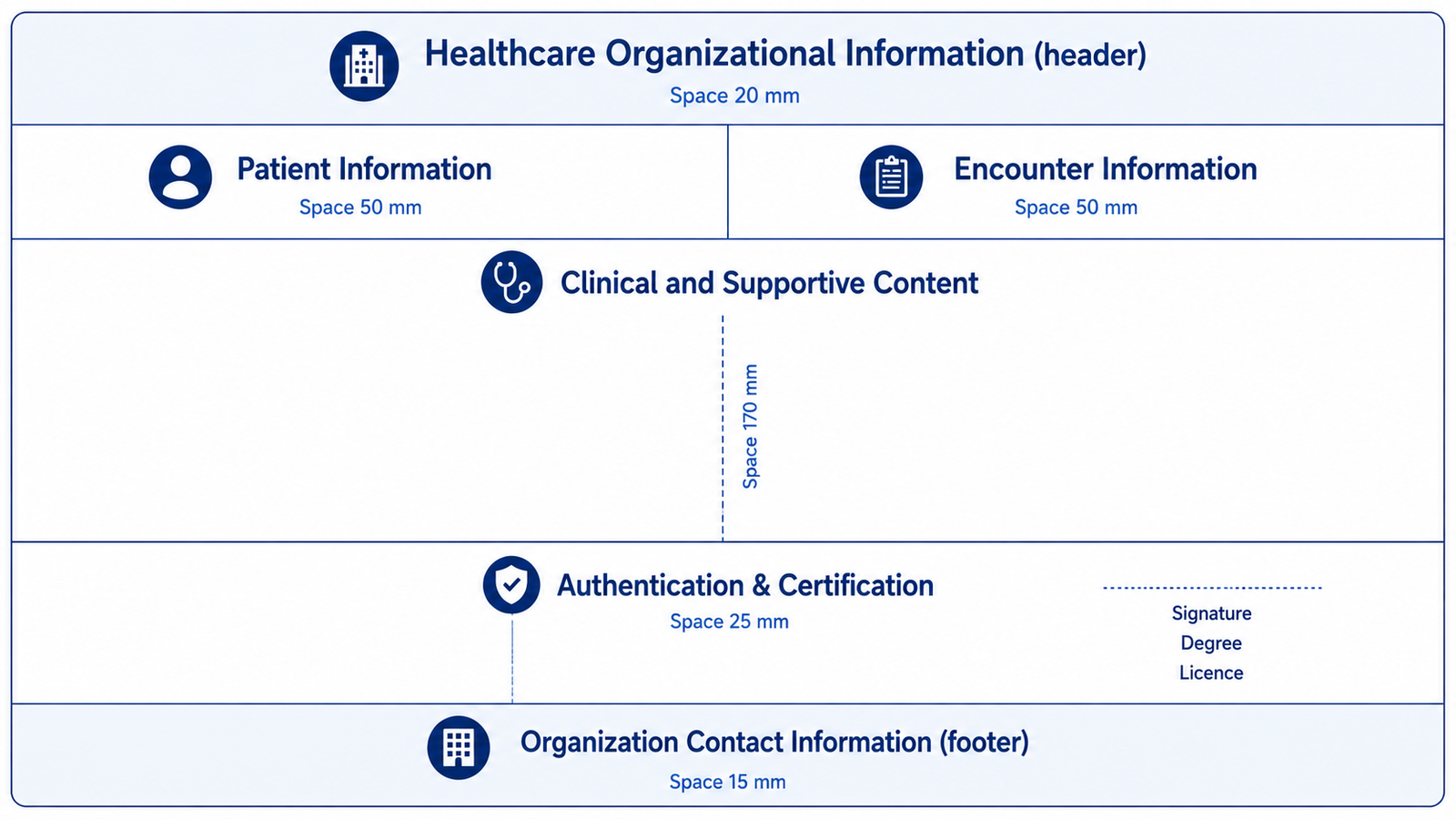
*(space measurements are for Illustrative)
For a detailed explanation of the OPD Reporting Framework and its design principles, see Supplement OPD Report Format. Supplement Departments and Services demonstrates how the same standardized reporting framework can be applied across different healthcare departments and services.
Benefits
- Promotes consistent clinical documentation.
- Improves continuity of care across healthcare providers.
- Supports information exchange, interoperability, and healthcare connectivity.
- Provides a standardized foundation for future digital healthcare technologies.
Suggestion
Healthcare professionals should be supported by standardized clinical documentation and user-friendly digital healthcare systems. The system should minimize manual data entry by providing structured selections, reusable information where appropriate, and intuitive workflows, allowing healthcare professionals to spend more time on patient care and clinical decision-making with minimal typing and administrative effort.
Patient pathways Following OPD:
- Pharmacy
- Inpatient Admission (IPD)
- Surgery / Procedures
- Referral
- Follow-up
- Discharge
Diagnostic Services (Pathology)
The Pathology Reporting Framework provides a standardized approach for creating pathology report formats across different diagnostic services. Using standardized Healthcare Data Elements, the framework organizes diagnostic information into a consistent reporting structure while allowing laboratories and diagnostic services to document only the information required for the specific investigation.
Figure Pathology Reporting Format presents an illustrative Pathology Report Format generated using standardized Healthcare Data Elements. The same standardized information foundation can be used to generate reporting formats for different diagnostic services while maintaining a consistent reporting structure, diagnostic workflow, and continuity of healthcare information throughout the patient's healthcare journey.
Pathology Reporting Format
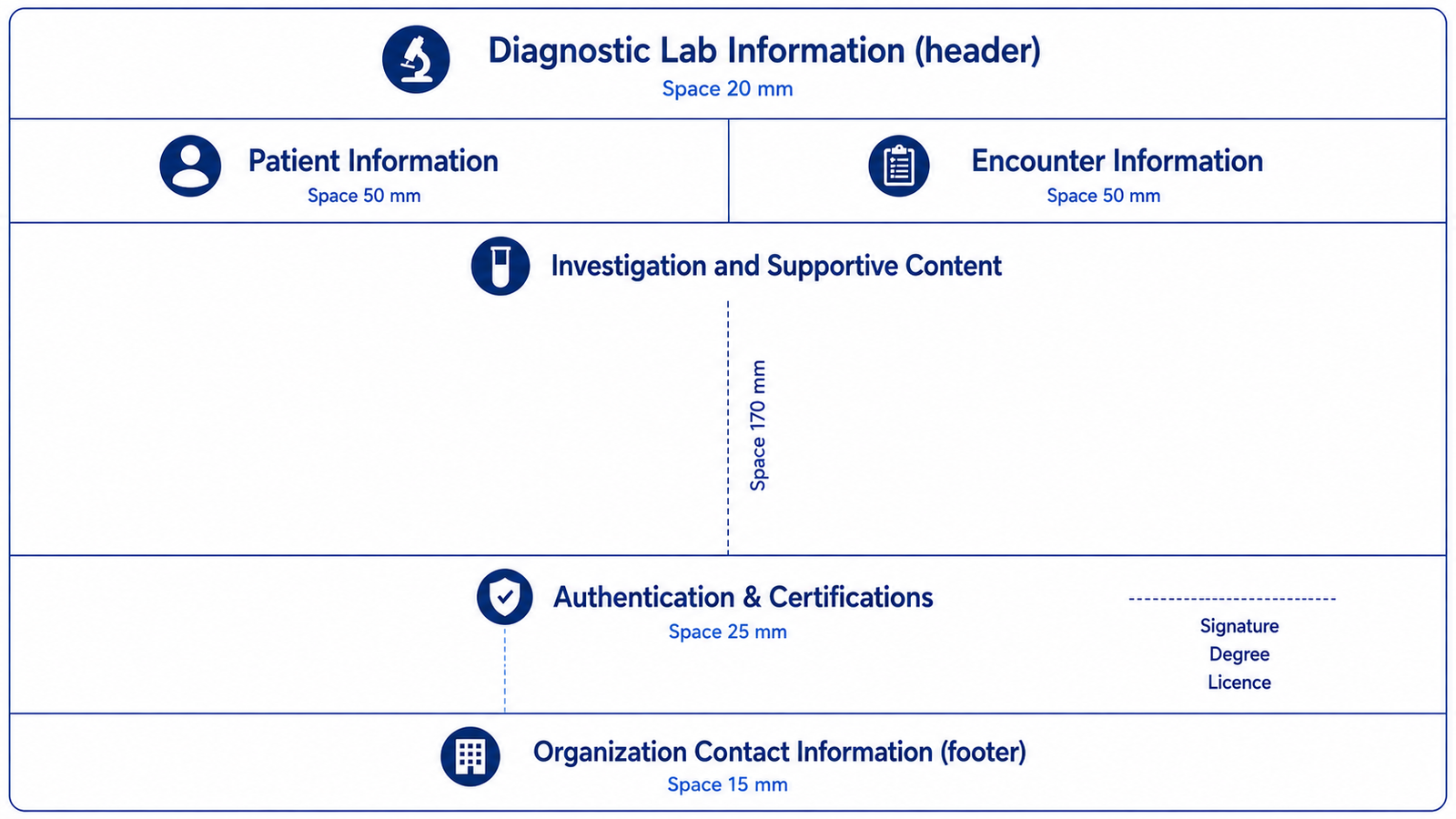
*(space measurements are for Illustrative)
For a detailed explanation of the Pathology Reporting Framework and its design principles, see Supplement Pathology Report Format, which illustrates how standardized Healthcare Data Elements are organized into a consistent diagnostic reporting structure.
International Healthcare Standards
Healthcare information is supported by several internationally recognized standards that promote consistency, interoperability, and the exchange of healthcare information. Each standard serves a specific purpose within the healthcare information ecosystem, collectively providing a common language for recording, exchanging, interpreting, and managing healthcare information. The proposed AMDEES framework complements these internationally recognized standards by providing a standardized healthcare information structure that supports their consistent implementation within healthcare workflows.
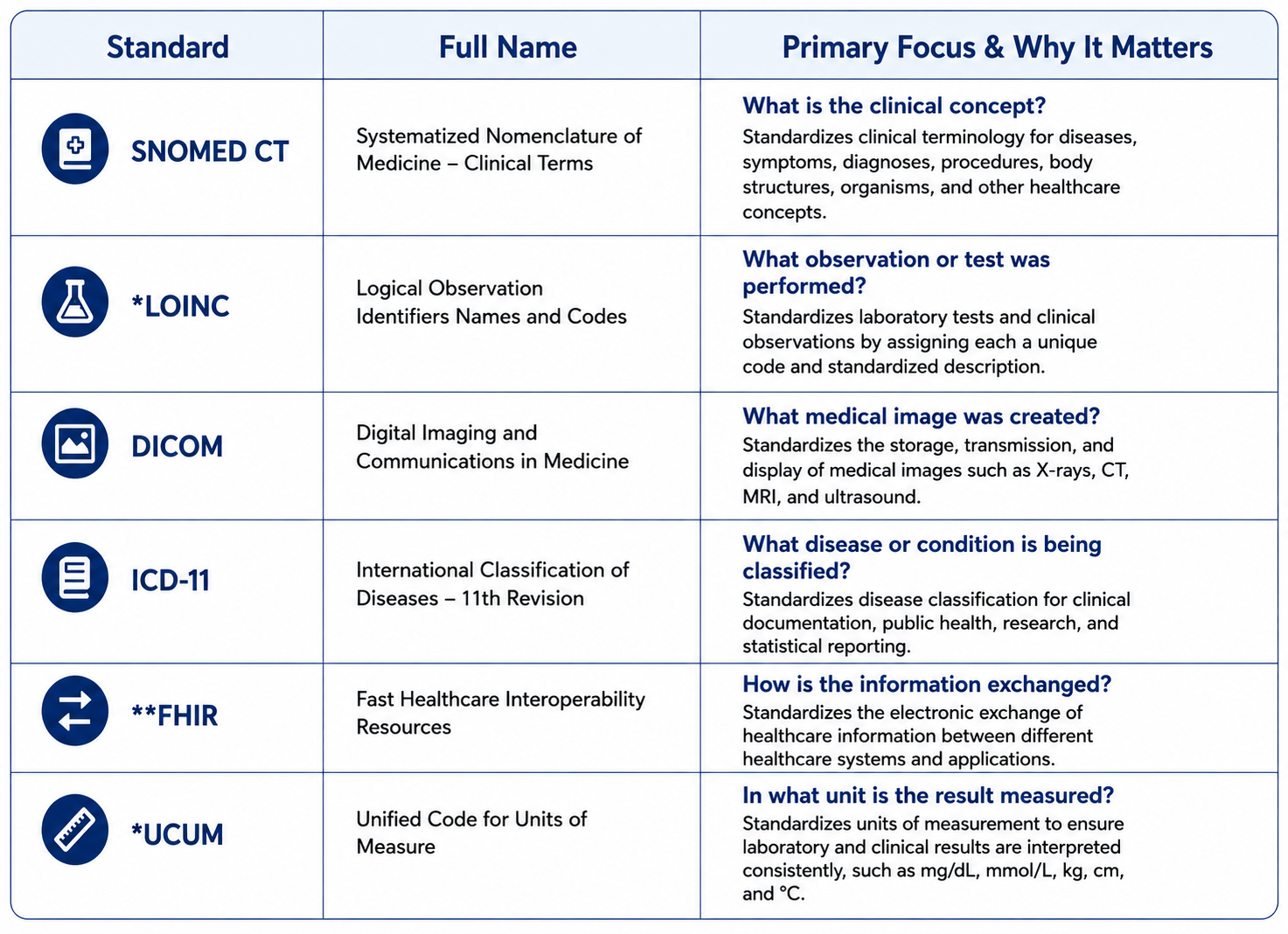
As laboratory reporting forms the basis of the illustrative implementation presented in this chapter, LOINC and UCUM are used as representative international standards to demonstrate how the proposed AMDEES framework integrates with existing global healthcare standards.
FHIR provides the internationally recognized standard for exchanging healthcare information between different healthcare systems and applications. The proposed AMDEES Healthcare Data Elements Framework establishes standardized healthcare information that can be consistently organized, implemented, and exchanged using interoperability standards such as FHIR.
LOINC – Logical Observation Identifiers Names and Codes
For the purpose of demonstrating the proposed framework, this chapter uses LOINC (Logical Observation Identifiers Names and Codes) as the illustrative standard for laboratory reporting. LOINC is an internationally recognized standard that assigns a unique code and standardized name to each laboratory observation, enabling consistent identification, interpretation, and exchange of laboratory information across different healthcare systems.
For example, a fasting blood glucose test is represented in LOINC as:
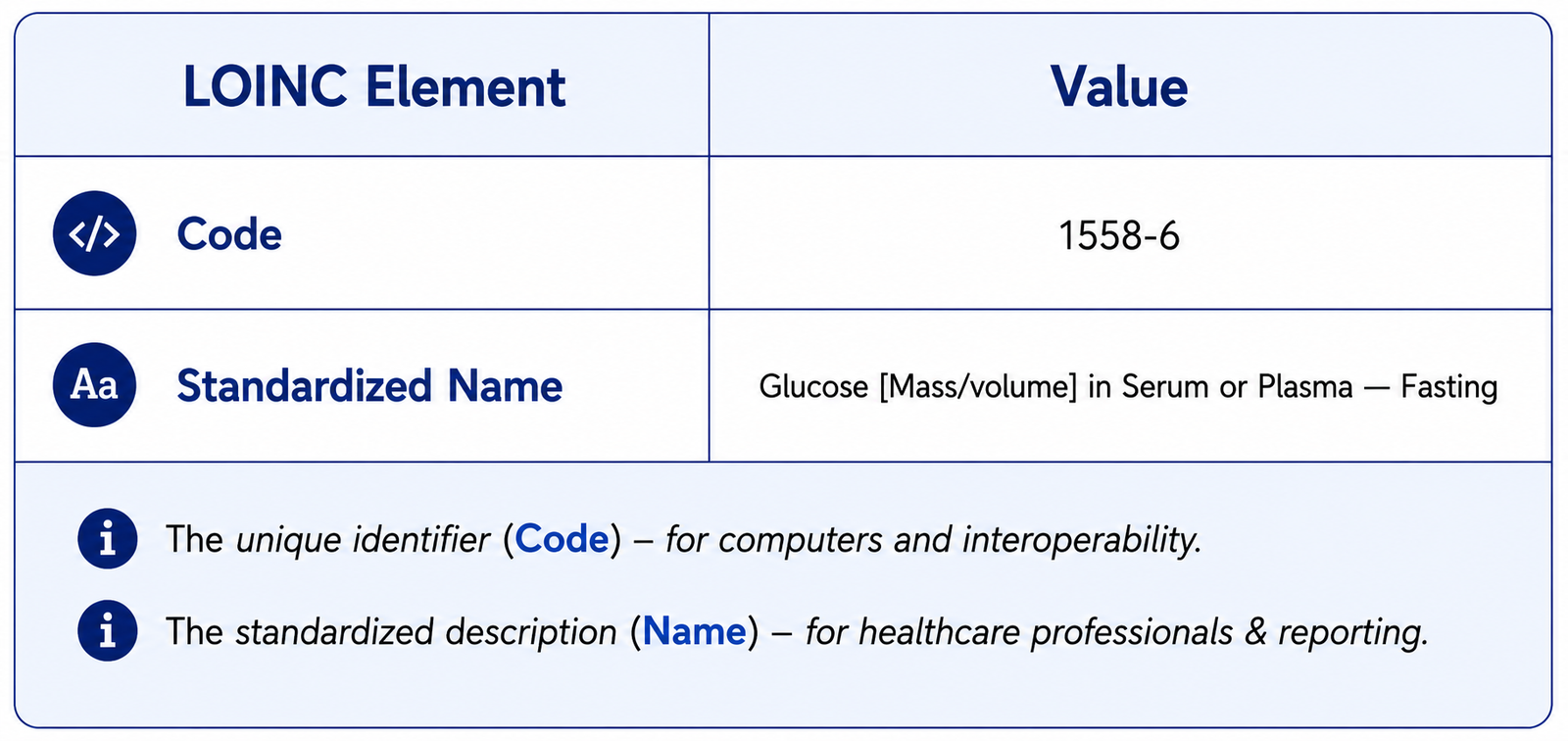
This standardized description defines the essential characteristics of the laboratory observation:
- Glucose – the substance being measured (analyte).
- Serum or Plasma – the specimen used for testing.
- Fasting – the patient preparation or collection condition.
The LOINC code (1558-6) uniquely identifies this laboratory observation, while the standardized name describes exactly what is being measured, how it is measured, which specimen is used, and under what collection condition. Together, they enable healthcare professionals, laboratories, and healthcare information systems to consistently interpret and exchange laboratory information, regardless of where the test is performed.
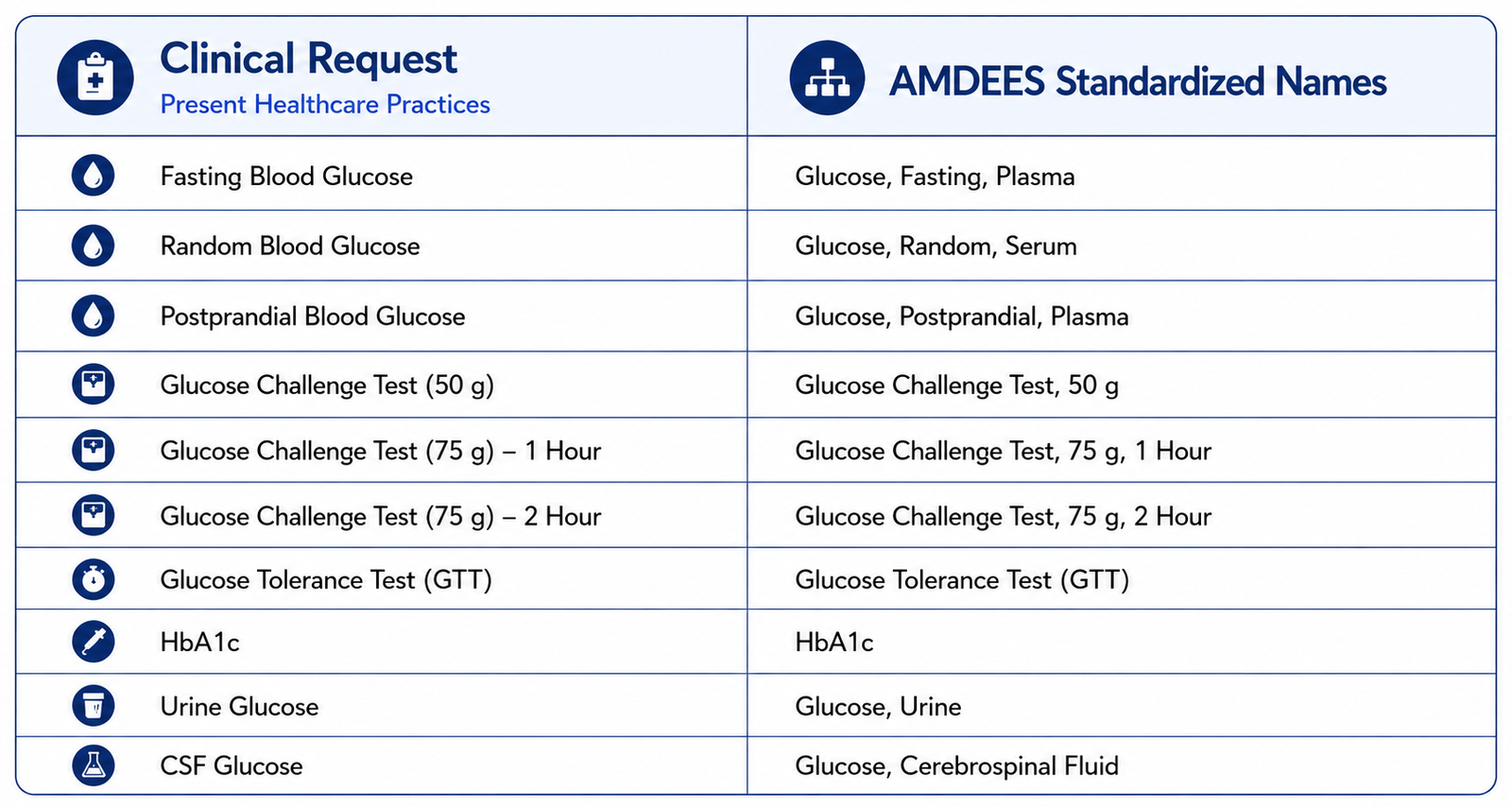
Clinical Request & Standardized Names Mapping
UCUM (Unified Code for Units of Measure)
UCUM (Unified Code for Units of Measure) is the international standard for representing units of measurement. It ensures that laboratory results are expressed using standardized units, enabling healthcare professionals and healthcare information systems to accurately interpret and exchange laboratory data.
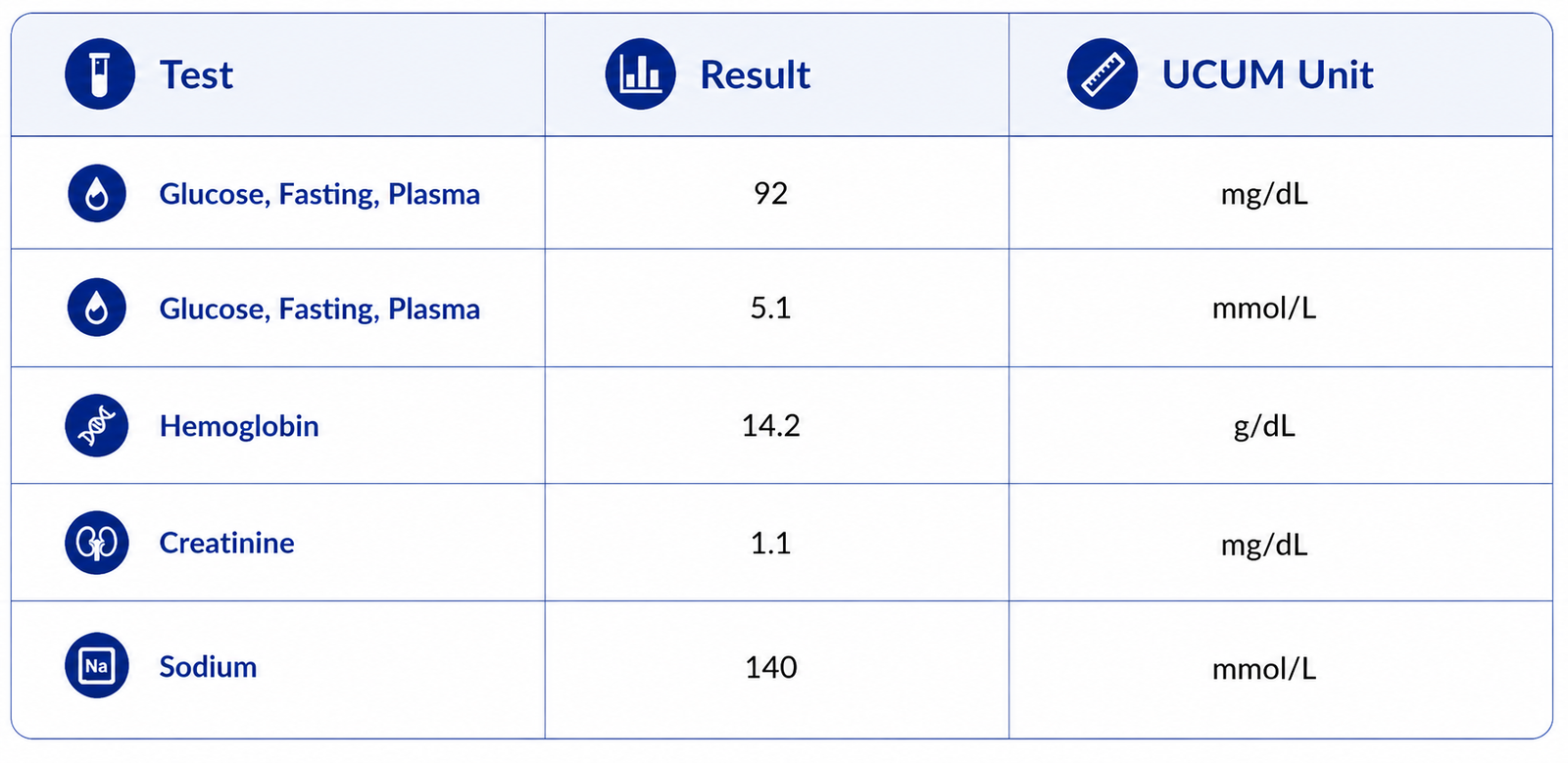
In the proposed framework, LOINC identifies the laboratory observation, while UCUM standardizes the unit in which the result is reported. Together, they ensure consistent interpretation and interoperability of laboratory information.
The illustrative implementation presented in this chapter demonstrates how standardized Healthcare Data Elements can be integrated with internationally recognized standards such as LOINC and UCUM to create consistent laboratory documentation. This standardized approach enables healthcare information to be interpreted, exchanged, and compared consistently across different healthcare organizations. The following illustrative comparison of pathology reports demonstrates the practical value of standardized healthcare information by enabling consistent interpretation, meaningful comparison, and better clinical decision-making.
Illustrative Comparison Pathology Reports
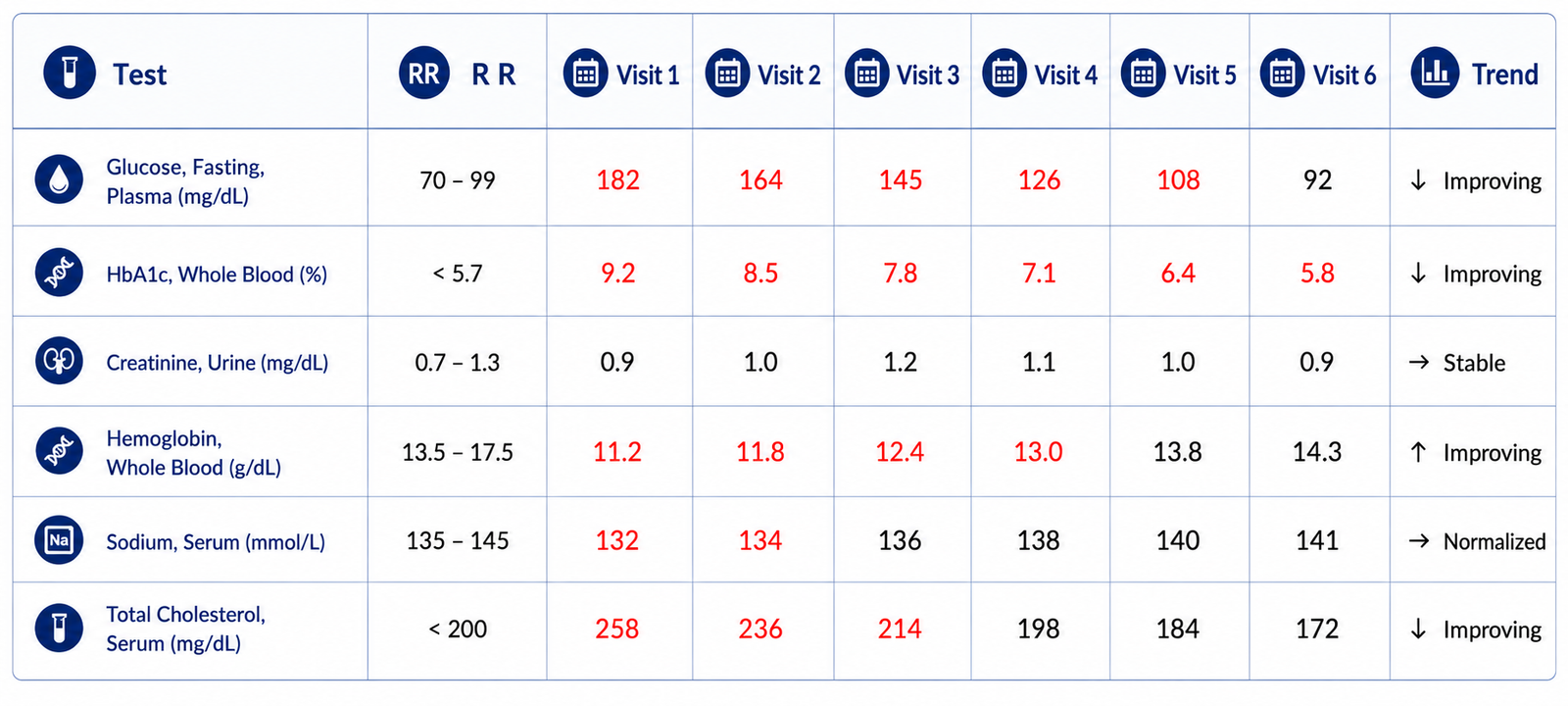
The above chart will work for both, digital as well as paper.
For the Healthcare Professional
- Disease progression or recovery is visible immediately.
- Treatment effectiveness can be assessed at a glance.
- Unnecessary searching through multiple reports is avoided.
- Trends support better clinical decision-making.
For the Patient
- Progress is easy to understand.
- Improvements encourage treatment adherence.
- Changes can be discussed more effectively with healthcare professionals.
- Historical laboratory information remains organized and meaningful.
The illustrative examples presented throughout this chapter demonstrate that healthcare standardization extends beyond individual forms and reports. By organizing standardized Healthcare Data Elements within a common reporting framework and integrating internationally recognized standards, healthcare information can be consistently interpreted, exchanged, and compared across different healthcare organizations. This provides a practical foundation for interoperability, continuity of care, and future Electronic Health Records.