The Healthcare Reporting Framework establishes a standardized document architecture for presenting healthcare information consistently across healthcare organizations and specialties. Rather than prescribing specialty-specific clinical content, the framework standardizes the structure and presentation of healthcare information, improving readability, and supporting information exchange, interoperability, healthcare connectivity, and future digital healthcare technologies.
Healthcare professionals make clinical decisions by interpreting information rather than reading every word on a page. A consistent document structure enables important healthcare information to be located, interpreted, and compared more quickly while reducing unnecessary visual searching.
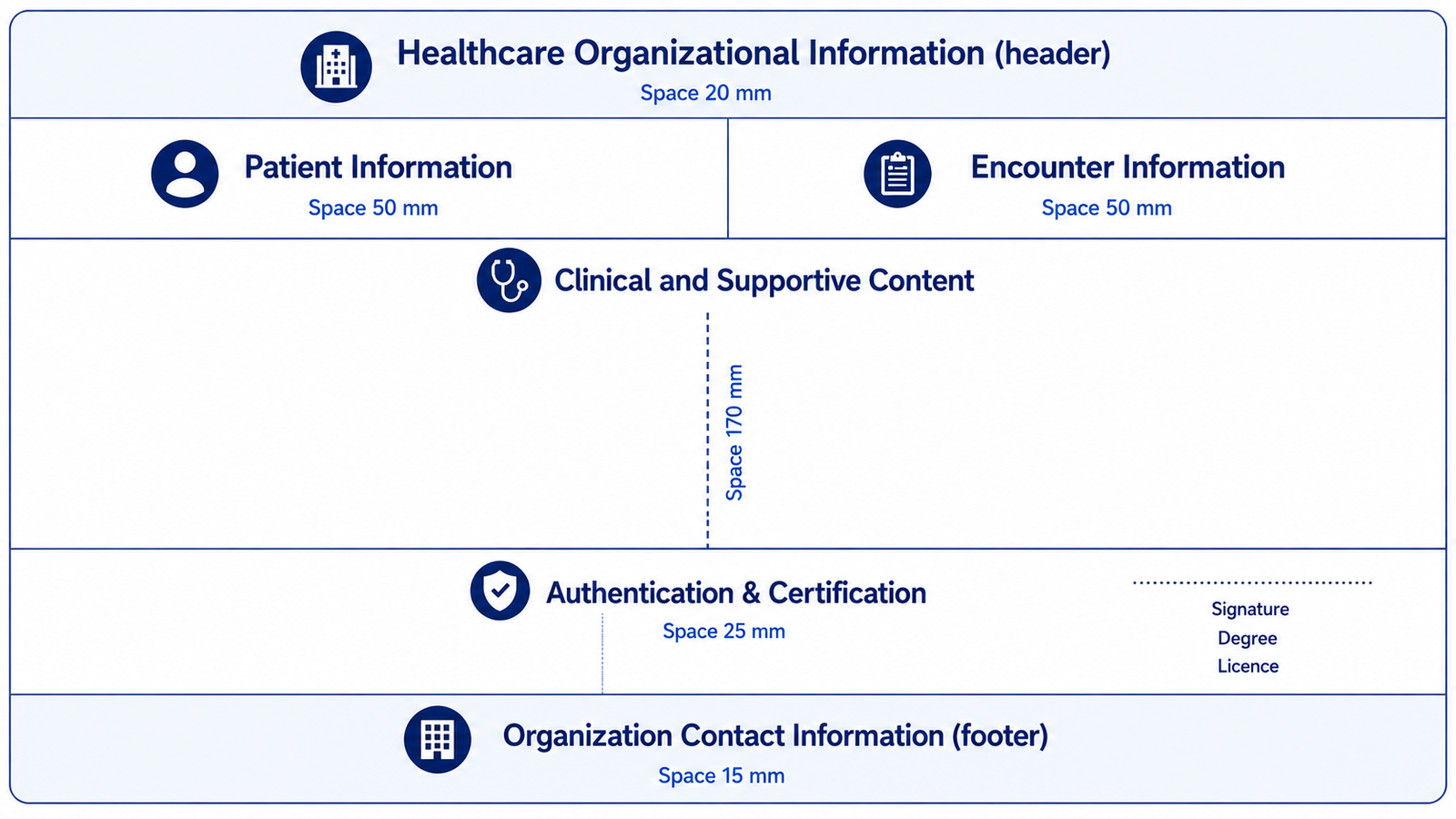
The proposed framework establishes a consistent document architecture by organizing healthcare information into five standardized sections. This enables critical information to appear in predictable locations while reserving the largest allocation of document space for clinical documentation.
The framework standardizes the structure and presentation of healthcare reports. The dimensions shown are illustrative and represent a practical reference design. They may be refined during the standardization process by the respective multidisciplinary expert panels while preserving the standardized reporting architecture.
The figure demonstrates how standardized National Healthcare Data Elements are organized into an illustrative OPD Report using the proposed National Healthcare Reporting Framework. The selected Data Elements are arranged to meet the clinical documentation requirements of an OPD consultation while maintaining a consistent reporting structure.
The illustrative OPD Report demonstrates the practical application of the Healthcare Reporting Framework. While the clinical content is specific to OPD services, the same standardized reporting structure can be applied to other healthcare departments and services, with each report organized using the same standardized document architecture.